August 18, 2026
Multi-View Image Generation with In-Context LoRA
An honest, work-in-progress attempt at teaching FLUX to keep an object's identity straight across four views
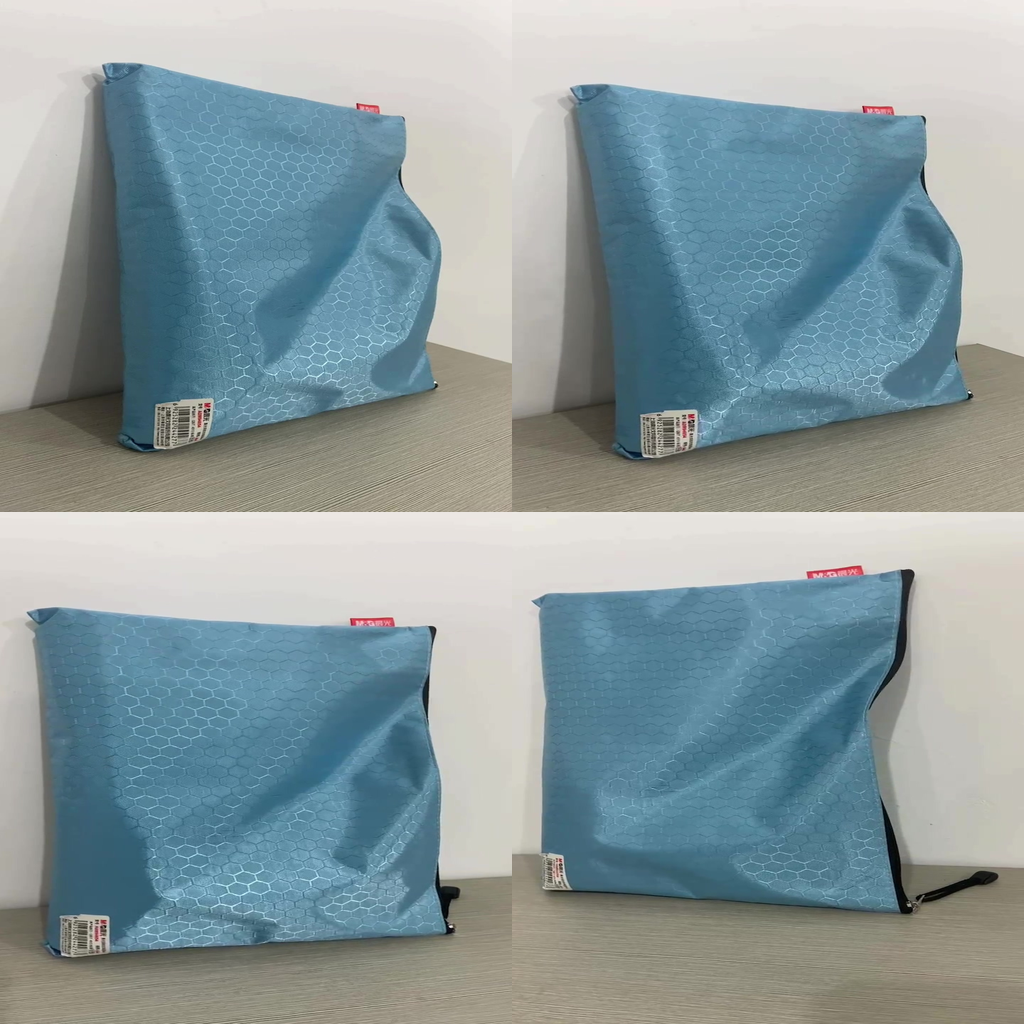
Ever since finishing up the wrinkle segmentation project, I've been circling a bigger question: not just recognizing what's flat in a single image, but understanding an object well enough to picture it from angles you haven't actually shown the model. That's the "physical AI" itch I keep mentioning on my homepage — how do machines understand and reason about our messy 3D world from a handful of 2D photos? This post is my newest (and still very much unfinished) attempt at chipping away at that, and I'd rather write it up honestly mid-flight than wait for a tidy ending that may be months away. Code's here: In-Context-multiview-img-generation.
The question I'm actually testing
The approach builds on In-Context LoRA, a technique for adapting diffusion transformer (DiT) models — I'm using FLUX — to multi-image outputs without touching the model architecture. The trick is deceptively simple: concatenate several images of the same object into one big composite (a 2×2 grid, in my case), write a single joint caption describing all four sub-images, and fine-tune on a small dataset with LoRA. Because LoRA only inserts trainable low-rank matrices into the attention layers and freezes everything else, the whole thing trains on a single RTX 4090 instead of a GPU cluster — the same reason I like it for the fine-tuning work I described in my SDXL post.
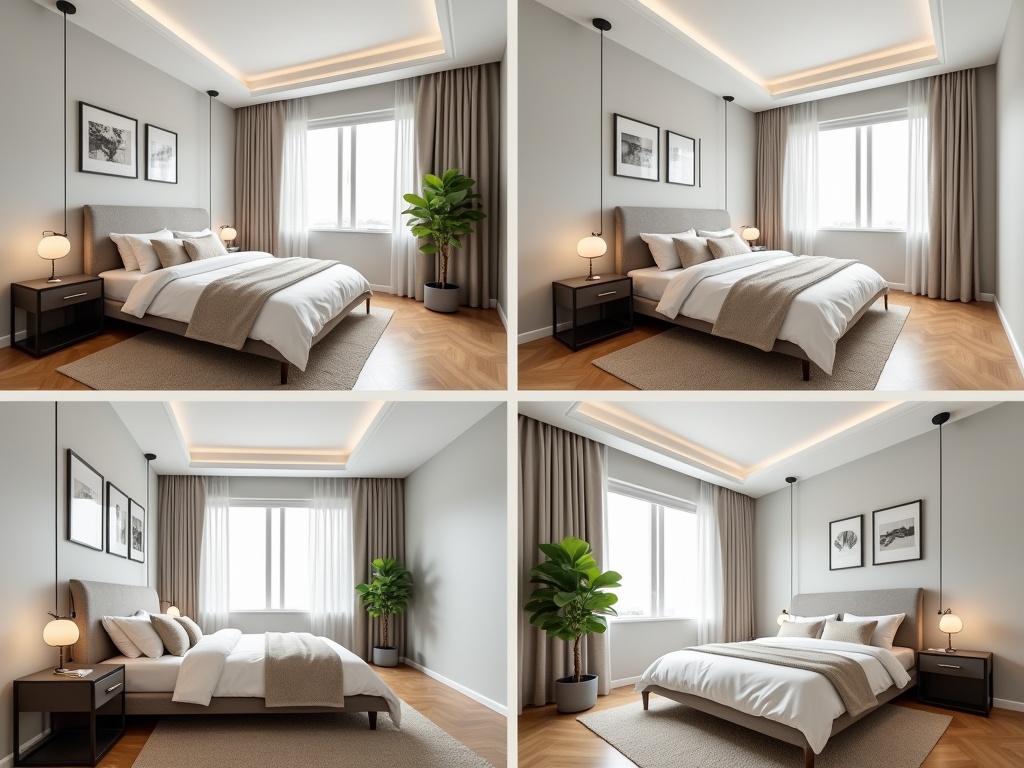
The original In-Context LoRA paper only evaluated results qualitatively — someone eyeballed the generated grids and decided if they looked coherent. That bugged me, because "looks fine" is exactly how you miss a model quietly duplicating the same view four times and calling it four angles. So the actual research question I'm chasing is: does LoRA preserve object identity across views, or does it just learn to copy-paste the input with minor noise? Answering that properly means building a real evaluation pipeline, not just staring at grids like the cover photo above — more on that below.
Building the dataset
The source data comes from MVImgNet, a large multi-view image dataset. From it, I deterministically select four well-spaced views per object and concatenate them into a composite. Writing a single caption that accurately describes all four sub-images by hand doesn't scale, so I automated it with gemini-3.5-flash, constrained to a Pydantic schema (MultiviewAnnotation) that forces the model to return a structured viewpoint, side, vertical angle, framing, and confidence for each tile rather than free-form text. Annotations the model flags as indeterminate get routed to a separate abstention set instead of silently entering the training data — better an honest "I don't know" than a wrong pose label baked into the dataset.
The most recent full run (July 2026) processed every eligible instance under data/:
| Item | Result |
|---|---|
| Eligible four-view instances | 529 |
| Selected source images | 2,116 |
| Accepted image/caption pairs | 423 |
| Abstention composites | 106 |
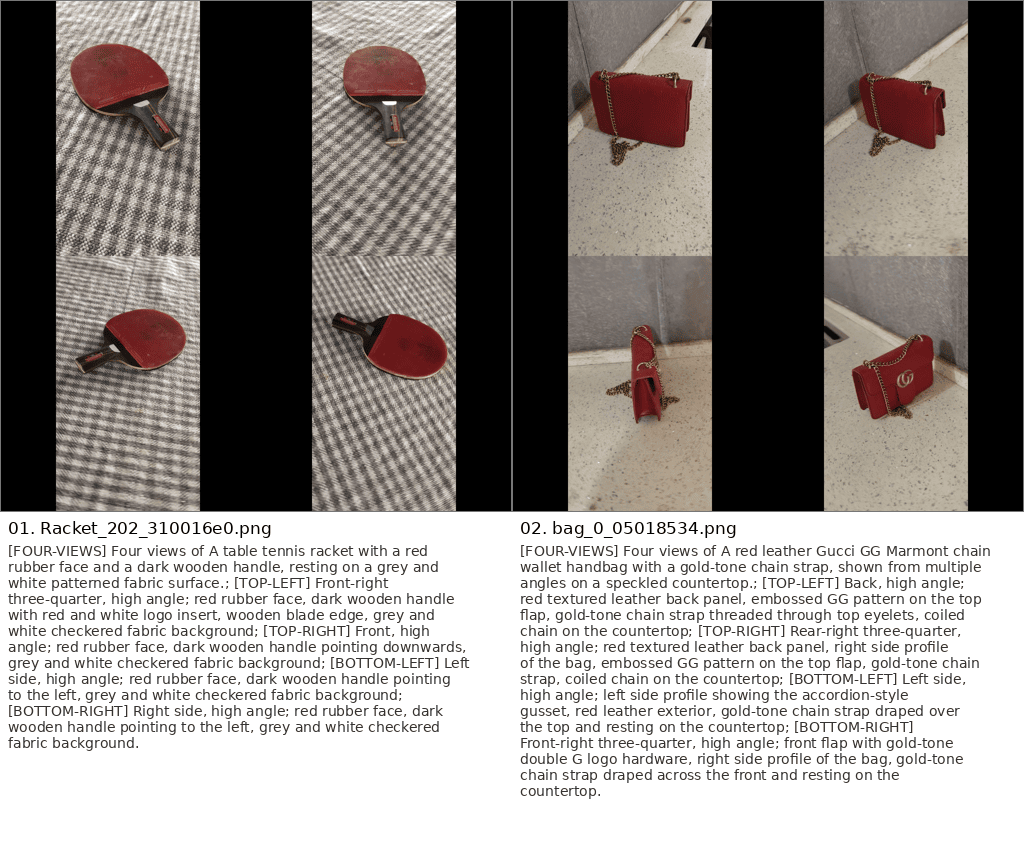
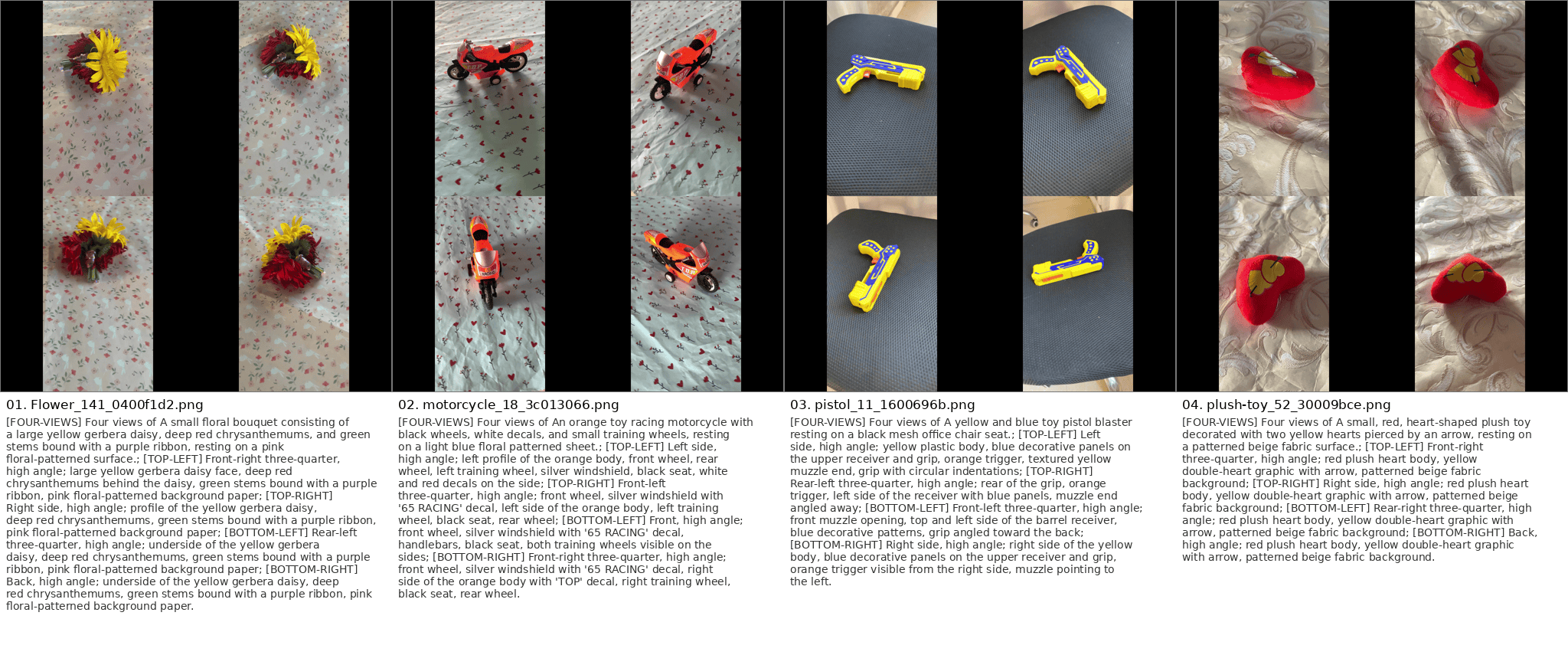
Here's what the accepted pairs actually look like — the composite next to the exact structured caption the pipeline generated:
Where things stand right now
To be upfront: this is not a finished project, and I don't want to dress it up as one. What's actually done:
- Deterministic four-view selection and composite construction, with duplicate-image hashing.
- The Gemini-based structured captioning pipeline above, including a resumable Batch API workflow for running it over hundreds of composites without babysitting it.
- A reproducible 90/10 train/holdout split of the 423 accepted pairs (seed 17 → 381 train / 42 holdout), with leakage checks so no source instance or image hash leaks across the split.
- A minimal Study 1 pilot LoRA config (rank 16, 500 steps) trained via AI-toolkit, plus a harness that generates paired base-FLUX-vs-LoRA outputs and a blinded scorecard for human raters.
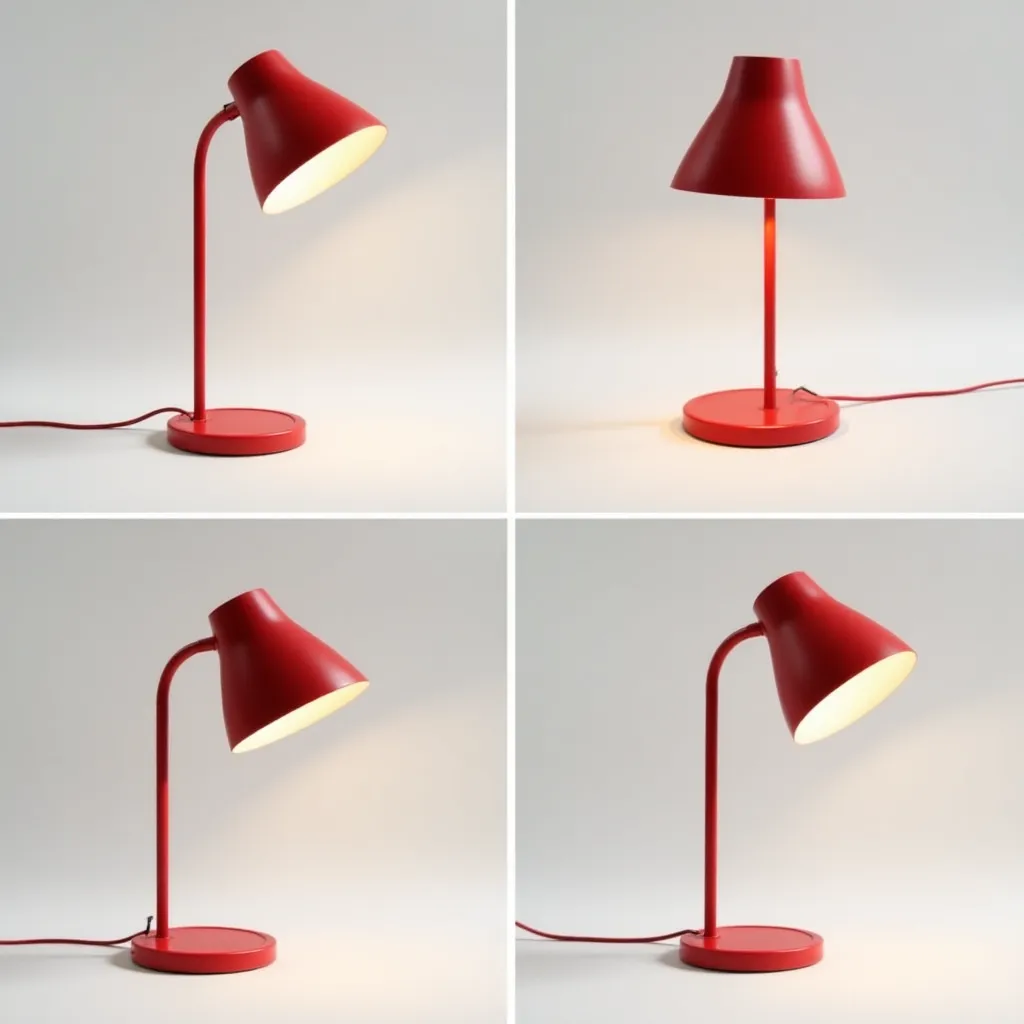
What I'm explicitly not claiming yet is a finished evaluation — the blinded scoring hasn't been run to completion, and I don't have DINOv2/DreamSim/LPIPS numbers to show you instead of "trust me, it looks okay." The two example generations below predate the current structured-captioning pipeline entirely, and I'm keeping them purely as historical curiosities, not as evidence of anything:
You can try the current LoRA checkpoint yourself without any of this setup: Hugging Face Model Card and Hugging Face Demo Space.
What's next
The honest roadmap, straight from the repo:
- Review the 106 abstentions and spot-check the 423 accepted annotations before trusting them as clean training data.
- Build and adjudicate a 100-composite gold benchmark to actually measure captioning quality.
- Benchmark a handful of Gemini models against each other for viewpoint annotation.
- Train pose-conditioned and appearance-only LoRA variants, three seeds each, so I can separate "does it know the pose" from "does it keep the object looking like itself."
- Run the Study 1 pilot training through to a completed, blinded human scoring pass.
- Add DINOv2, DreamSim, LPIPS, and perceptual-hash metrics so identity preservation is a number, not a vibe.
If any of this overlaps with something you're working on — multi-view generation, structured VLM captioning, or evaluating diffusion models beyond "it looks fine to me" — I'd genuinely like to compare notes. Details on how to reach me are on the consulting page.
Useful resources
- In-Context-multiview-img-generation — full pipeline code, configs, and the
PLANS.mdwrite-up of the research questions. - In-Context LoRA — the original method this builds on.
- MVImgNet — the source multi-view dataset.
- AI-toolkit — the LoRA training harness I used for FLUX.
- Hugging Face Model Card and Demo Space.
Citation
Cited as:
Sandu, Raluca-Maria. (Aug 2026). Multi-View Image Generation with In-Context LoRA. rmsandu.net. https://rmsandu.net/blog/2026-08-18-multiview-lora.html
Or
@article{sandu2026multiviewlora,
  title   = "Multi-View Image Generation with In-Context LoRA",
  author  = "Sandu, Raluca-Maria",
  journal = "rmsandu.net",
  year    = "2026",
  month   = "Aug",
  url     = "https://rmsandu.net/blog/2026-08-18-multiview-lora.html"
}